Red yeast rice
Monascus purpureus
It lowers cholesterol, and it does so for the same reason a medicine does: it contains the same molecule. That explains its effect, it explains its risks, and it explains why the European Union has capped it. What it does not explain is how much the bottle you buy actually contains: of 37 European products analyzed, none held what its label declared.

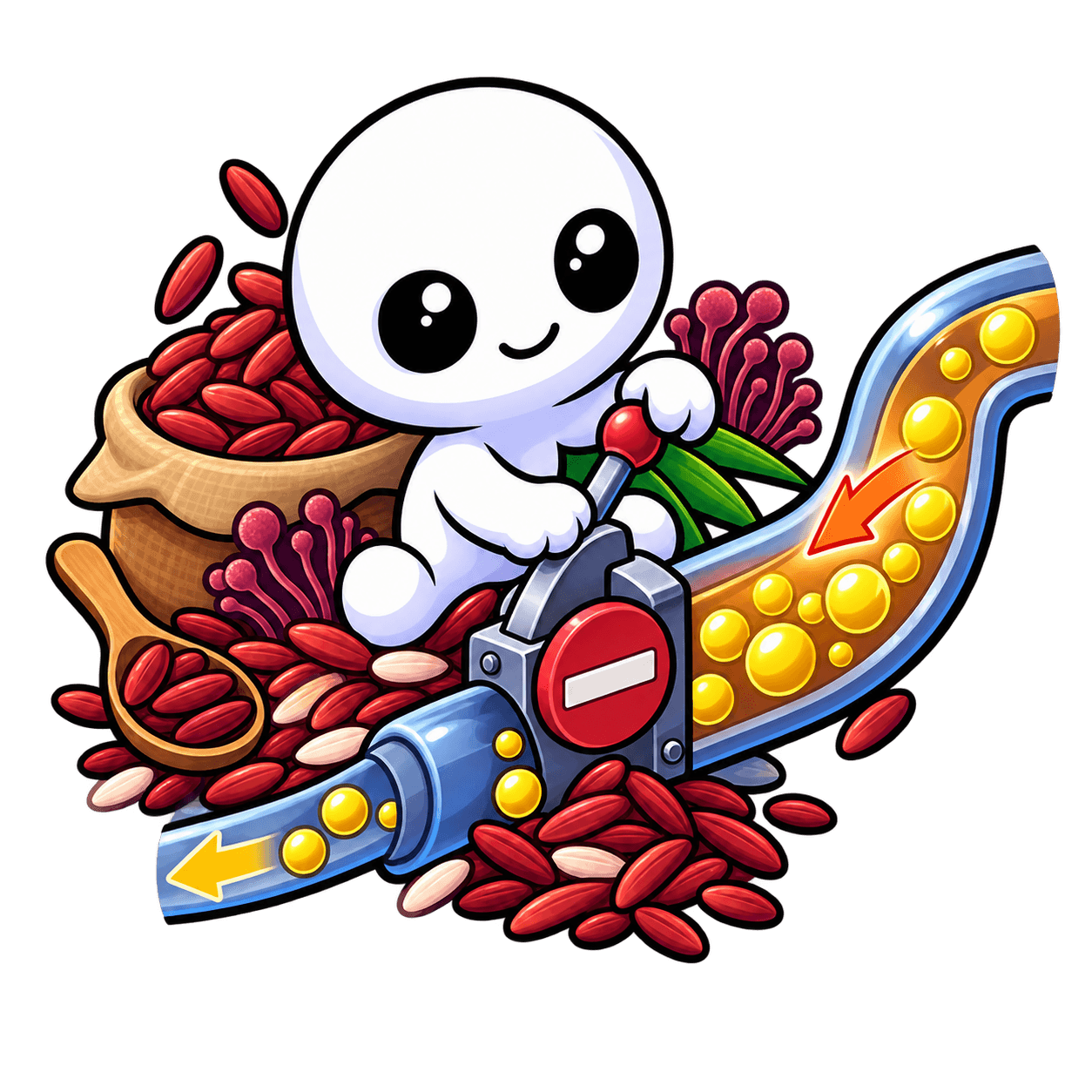
Closing the valve the liver uses to make cholesterol.
Before you read on
In the European Union, a red yeast rice supplement may not provide 3 mg or more of monacolins per day. The limit has been in force since June 2022.
In the United States the framework is different. In 2015, the US national center for complementary health reported that the medicines agency considers products with more than trace amounts of monacolin K to be unapproved drugs. It is the most recent position we have been able to date.
This page describes the framework of Spain and the European Union. Anyone reading from another country is governed by the rules that apply to them. And it describes what published studies have measured, without making recommendations.
What is red yeast rice?
It is rice fermented with Monascus purpureus, a fungus that dyes the grain red. In China it has been used for centuries as a food coloring and as a remedy for digestion and circulation.
During fermentation the fungus produces a family of compounds, the monacolins. The main one is monacolin K, which is chemically and structurally identical to lovastatin, the first drug in the family to reach the market. It is not similar: it is the same molecule.
That is where its effect lies. Monacolin K inhibits the enzyme the liver needs to make cholesterol, and the liver compensates by pulling more cholesterol out of the blood. It is the mechanism of a statin.
What is it for?
It lowers LDL cholesterol. Trials with find it and the that pool them confirm it, with a magnitude similar to that of one of the lower-potency statins.
A single trial has looked beyond the blood test to see whether those who take it have fewer heart attacks and live longer. It followed close to 5,000 Chinese people who had already had a heart attack for a mean of four and a half years, and found fewer coronary events and fewer deaths in the treated group. That result travels with some reservations: it was done only in a Chinese population, with the product of a single manufacturer, with an extract nobody fully characterized, and it is an old trial.
How much cholesterol drops in any one person depends on how much monacolin K the product they bought contains.
Who is it for?
Adults with high cholesterol, or who want to lower it, and who are not already taking a drug to lower it. That is the population the trials were done in.
How is it taken?
The monacolin K doses in the trials that found an effect on LDL cholesterol range from 3 to about 10 mg per day. The limit European law allows a supplement is below 3 mg per day.
On time of day there is no data specific to red yeast rice. The rationale is carried over from statins, which are usually taken at night because the liver makes cholesterol mainly then, and the medicine’s prescribing information indicates taking it with the evening meal, since food increases its absorption.
None of this is a Suplepedia protocol.
Absorption
Monacolin K reaches the body in its inactive form and the body converts it into the active one. Before reaching the circulation it passes through the liver, where it is processed by the same enzyme system that metabolizes a good share of all medicines. Hence it interacts with so many of them, and curiously with grapefruit juice.
Are all forms the same?
No. Products with very different amounts of monacolin K are sold under the same name. In an analysis of 28 brands bought in US stores, in two none was detected, and among the rest the amount ingested per day following each package’s instructions varied more than 120-fold.
In Europe, an analysis of 37 products found that none met the pharmaceutical quality criterion requiring the actual content to be between 95% and 105% of the declared amount.
The effect and the risk depend on how much monacolin K the specific package contains, and that is what a label rarely lets you check.
Quality seals
What do the studies say?
Myths
What science is still not clear about
Who should not take it?
European law requires the label of these products to carry five warnings. Four have prescribed wording: that it should not be consumed by anyone pregnant or breastfeeding, by children below 18 years old, or by adults above 70; that anyone experiencing any health problem should seek advice from a doctor on consumption of this product; that it should not be consumed by anyone already taking cholesterol-lowering medication; and that it should not be consumed together with other products containing red yeast rice. The fifth warns against reaching 3 mg of monacolins per day. The label must also state how many portions make up the maximum daily consumption and the monacolin content of each portion.
The warnings about cholesterol-lowering medication and about combining products have the same reason behind them: the effect adds up. Taking it while taking a statin, or taking two red yeast rice products at once, is raising the statin dose without anyone having calculated it.
It also shares the adverse effects of statins. The systems that collect reports from patients and doctors have accumulated cases of liver damage and of serious muscle damage, some with monacolin K doses as low as 3 mg per day. The placebo-controlled trials, which lasted a few months and did not include the people at highest risk, found no more liver or muscle problems than with placebo. Both things are true at once.